A few years ago, very few Indian consumers had heard of VinFast. Today, the Vietnamese electric vehicle company is rapidly transforming from an unfamiliar name into one of the most closely watched automotive brands entering India.
Often called the “Tesla of Vietnam,” VinFast is not simply launching a few electric vehicles and hoping for success. The company is investing billions of dollars, building manufacturing infrastructure, expanding dealership networks, signing financing partnerships, and creating an entire EV ecosystem designed to compete with established automotive giants.
The bigger question is no longer whether VinFast can enter India. The real question is whether VinFast can build enough scale to challenge companies that already dominate one of the world’s largest automotive markets.
Why India Matters So Much to VinFast
India represents one of the most important opportunities in the global electric vehicle industry.
Several factors make the country attractive:
- Rapid EV adoption
- Government support for electric mobility
- Growing middle-class demand
- Expanding charging infrastructure
- Rising fuel costs
- Large domestic vehicle market
For VinFast, India is not simply another market. It is a strategic manufacturing and growth hub that could determine whether the company becomes a global automotive player or remains a regional brand.
Vietnam’s domestic market alone is too small to support the scale required for long-term profitability. To survive and compete globally, VinFast needs access to high-growth markets with millions of potential customers.
India fits that requirement perfectly.
VinFast Has Officially Started Building Its Presence
VinFast has moved beyond announcements and plans.
The company has already introduced multiple electric vehicle models targeted at Indian consumers while simultaneously expanding its sales and financing network.
Recent developments include:
- Launch of the VF 6 electric SUV
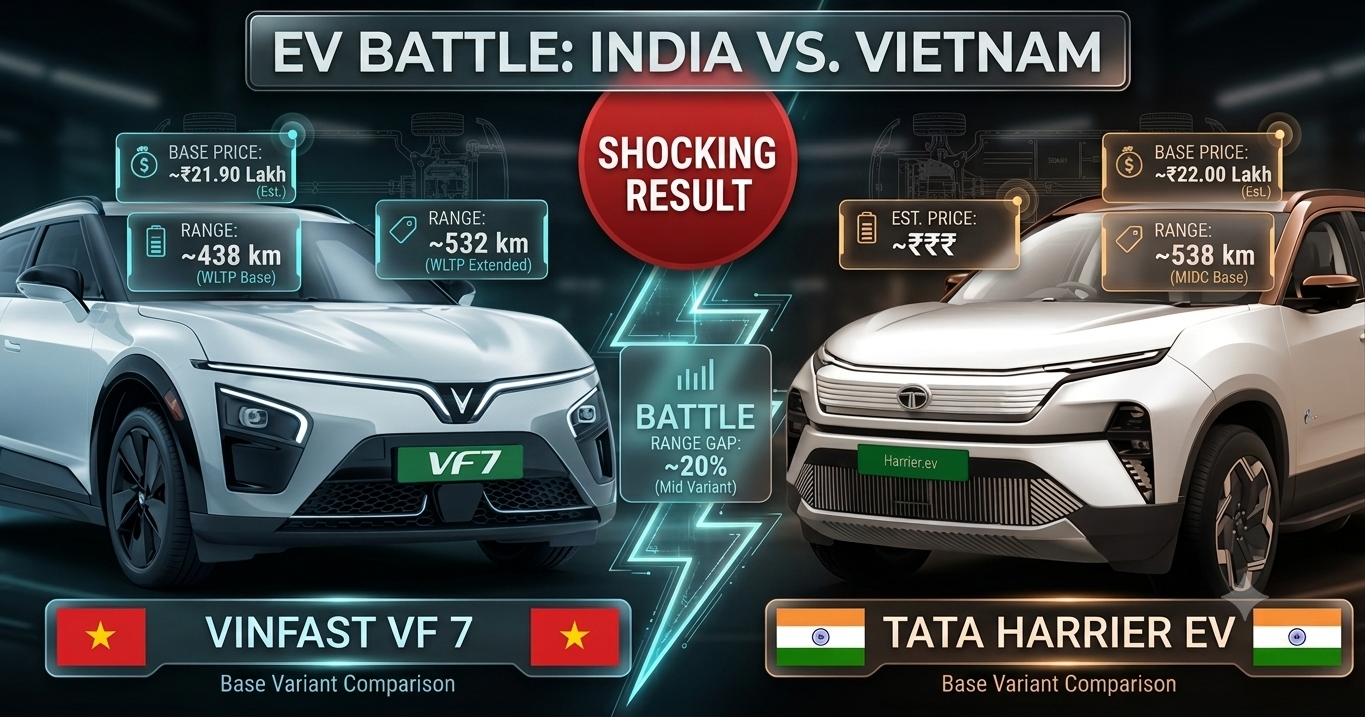
- Launch of the VF 7 electric SUV
- Introduction of the VF MPV 7 family-focused electric vehicle
- Expansion of dealership operations
- Strategic financing partnerships
- Growth of manufacturing operations in Tamil Nadu
Unlike many global automakers that test a market cautiously, VinFast appears to be pursuing aggressive expansion from day one.
The Four-Pillar Strategy Behind VinFast India
Many new automotive brands fail because they attempt to compete directly with established manufacturers using the same business model.
VinFast is taking a different approach.
1. Local Manufacturing Instead of Costly Imports
One of the biggest challenges for foreign automakers entering India is import duty.
Imported vehicles often become significantly more expensive than locally manufactured alternatives.
VinFast’s solution is straightforward:
- Build in India
- Manufacture in India
- Sell in India
The company’s major investment in Tamil Nadu supports this strategy.
Benefits include:
- Lower production costs
- Reduced import taxes
- Faster supply chains
- Better pricing flexibility
- Access to government incentives
This approach also aligns with India’s broader manufacturing ambitions.
2. Solving the EV Adoption Problem
Many consumers remain hesitant to purchase electric vehicles because of concerns surrounding charging infrastructure.
This issue, often called range anxiety, continues to affect EV adoption globally.
VinFast is attempting to reduce this concern through:
- Charging support programs
- Infrastructure partnerships
- Customer incentives
- Ecosystem development
Instead of focusing only on vehicle sales, the company is investing in the broader ownership experience.
3. Reducing Ownership Risk
One of the largest concerns among first-time EV buyers involves resale value.
Questions often include:
- Will the battery last?
- What will the car be worth in five years?
- Will technology become outdated?
VinFast has responded by promoting structured buyback and resale programs designed to provide buyers with greater confidence.
This strategy addresses an important psychological barrier that many automakers overlook.
4. Expanding Beyond Passenger Cars
Most EV manufacturers focus entirely on passenger vehicles.
VinFast appears to be thinking much bigger.
The company is exploring:
- Electric scooters
- Electric buses
- Commercial mobility solutions
This creates multiple revenue streams while increasing brand visibility across transportation sectors.
The Tamil Nadu Factory Could Become a Major Advantage
The company’s investment in Tamil Nadu may prove to be one of its most important decisions.
Manufacturing facilities provide advantages beyond production capacity.
They help create:
- Local jobs
- Supply chain ecosystems
- Vendor partnerships
- Faster market response
- Political goodwill
As production expands, VinFast may be able to compete more effectively on price against both domestic and international rivals.
The factory is also expected to support future vehicle categories beyond traditional passenger cars.
Lessons From VinFast’s Global Journey
While VinFast’s growth story is impressive, it has not been without challenges.
Success in Vietnam
The company has achieved remarkable success in its home market.
VinFast helped accelerate electric vehicle adoption and quickly established itself as a leading automotive brand.
Its compact EV models generated strong consumer interest and demonstrated the company’s ability to scale rapidly.
Challenges in North America
Expansion into the United States proved far more difficult.
Early vehicle reviews criticized:
- Software performance
- Driving experience
- Product refinement
These challenges highlighted the difference between entering emerging markets and competing in highly mature automotive regions.
The experience also forced VinFast to improve product quality and execution.
Southeast Asia Expansion
The company continues expanding across Southeast Asia using a strategy similar to India:
- Local manufacturing
- Dealer expansion
- Financing support
- Ecosystem development
This regional approach could help VinFast build sustainable scale over time.
The Man Behind the Vision
Understanding VinFast requires understanding Phạm Nhật Vượng.
As Vietnam’s first billionaire and the leader of Vingroup, he has become one of the most influential business figures in Southeast Asia.
His entrepreneurial journey began with a food business before evolving into a diversified conglomerate spanning:
- Real estate
- Education
- Healthcare
- Retail
- Technology
- Automotive manufacturing
What makes VinFast unique is the level of personal commitment behind it.
Building a global automotive company requires enormous capital, patience, and risk tolerance.
VinFast’s rapid expansion reflects a leadership philosophy focused on speed, scale, and long-term positioning.
Can VinFast Actually Challenge Tata and Mahindra?
This is where the debate becomes interesting.
Tata Motors and Mahindra possess significant advantages:
- Strong brand recognition
- Established dealer networks
- Local manufacturing expertise
- Deep customer trust
- Existing EV portfolios
However, VinFast brings advantages of its own:
- Aggressive expansion strategy
- Dedicated EV focus
- Global ambitions
- Large-scale investment
- Flexible business model
Success will likely depend on execution rather than ambition.
The Indian automotive market has historically rewarded companies that understand local consumers, maintain competitive pricing, and provide strong after-sales support.
VinFast must excel in all three areas.
What This Means for India’s EV Industry
Regardless of whether VinFast becomes a market leader, its arrival benefits the broader industry.
Increased competition typically drives:
- Better vehicle quality
- Faster innovation
- Improved customer service
- More affordable pricing
- Expanded EV adoption
Consumers often benefit the most when new challengers enter established markets.
Final Thoughts
VinFast India represents one of the most ambitious automotive expansion stories currently unfolding in Asia.
Backed by billions of dollars, supported by local manufacturing, and driven by a long-term vision, the company is attempting something few automotive startups have successfully achieved: becoming a global vehicle manufacturer.
The road ahead remains challenging. Competition from Tata, Mahindra, Hyundai, MG, and future entrants will be intense.
Yet VinFast’s strategy suggests that it is not entering India merely to participate. It is entering with the intention of becoming a major force in the country’s electric mobility future.
Whether that ambition translates into lasting success will be one of the most fascinating business stories to watch in the coming years.