

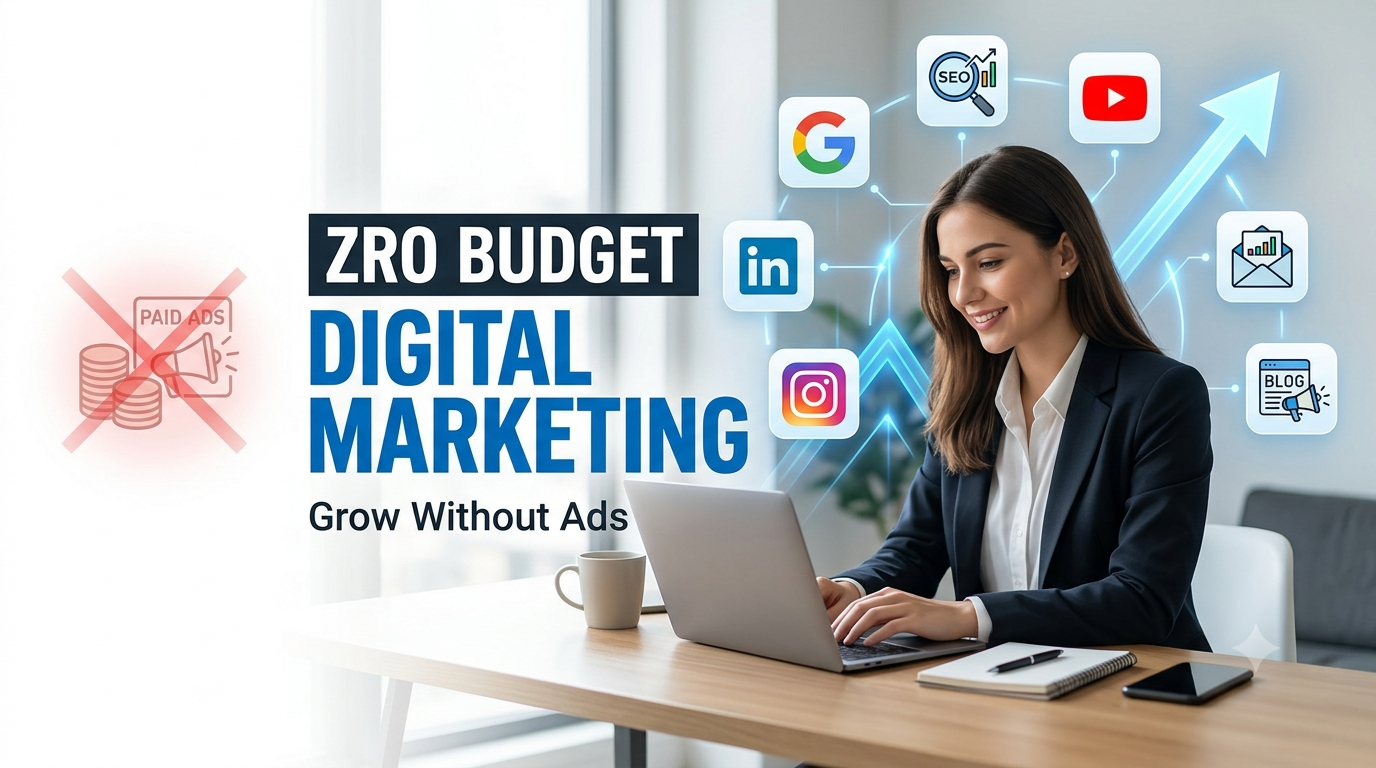
The Biggest Lie in Marketing
Imagine two entrepreneurs.
The first launches a business with ₹10 lakh reserved for Facebook Ads, Google Ads, influencer collaborations, and paid promotions.
The second has almost no marketing budget. His website is new, his Instagram account has barely 50 followers, and nobody knows his brand.
Now here’s the surprising part.
After two years, the second entrepreneur has built a loyal audience, ranks on Google, receives leads every day, and customers trust his brand.
Meanwhile, the first entrepreneur is still spending money every month just to keep sales coming.
What made the difference?
It wasn’t luck.
It wasn’t a bigger product.
It wasn’t even better marketing skills.
It was understanding one simple truth:
Marketing is not about spending more money. Marketing is about earning more attention.
Paid Marketing vs Zero Budget Marketing
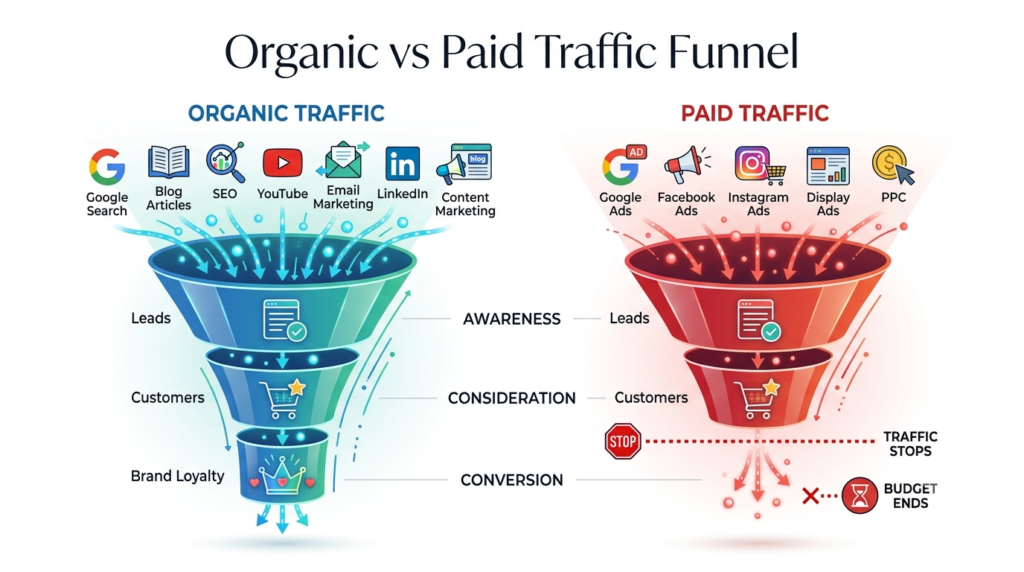
| Factor | Paid Marketing | Zero Budget Marketing |
|---|---|---|
| Initial Cost | High | Low |
| Long-Term ROI | Medium | High |
| Speed | Fast | Slow |
| Sustainability | Stops with Budget | Continues for Years |
| Trust Building | Medium | High |
| Scalability | Depends on Budget | Depends on Content |
That single mindset separates brands that disappear after their advertising budget runs out from brands that continue attracting customers for years.
Today, we live in an era where attention has become the world’s most valuable currency.
People don’t buy products because they see advertisements.
They buy from brands they remember.
And people remember brands that consistently provide value.
If you’re a startup founder, freelancer, creator, local business owner, or someone building something from scratch, this guide is for you.
Because you don’t need millions to market your business.
You need strategy.
Why Most Businesses Believe Marketing Requires Money
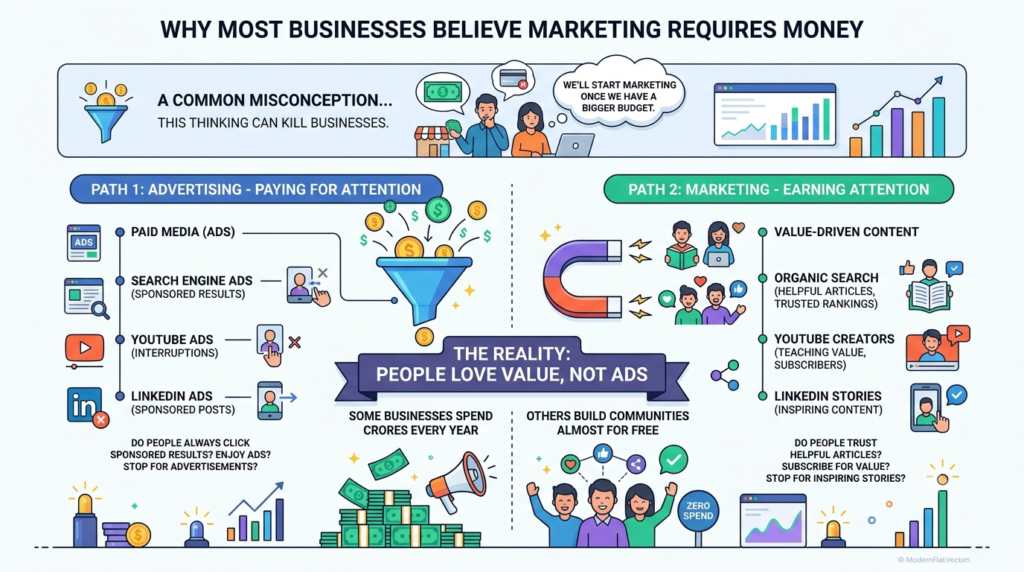
Ask any new business owner about marketing, and you’ll often hear the same response.
“We’ll start marketing once we have a bigger budget.”
Unfortunately, this thinking kills more businesses than competition ever does.
Marketing and advertising are not the same thing.
Advertising is paying for attention.
Marketing is earning attention.
Think about it.
When you search something on Google, do you always click the sponsored result?
Or do you trust the helpful article ranking organically?
When you watch YouTube, do you enjoy the ads?
Or do you subscribe to creators who consistently teach you something valuable?
When you scroll LinkedIn, do you stop for advertisements?
Or do you stop for stories that inspire you?
People don’t naturally love advertising.
People naturally love value.
That’s why some businesses spend crores every year while others build communities almost for free.
The Attention Economy Has Changed Everything
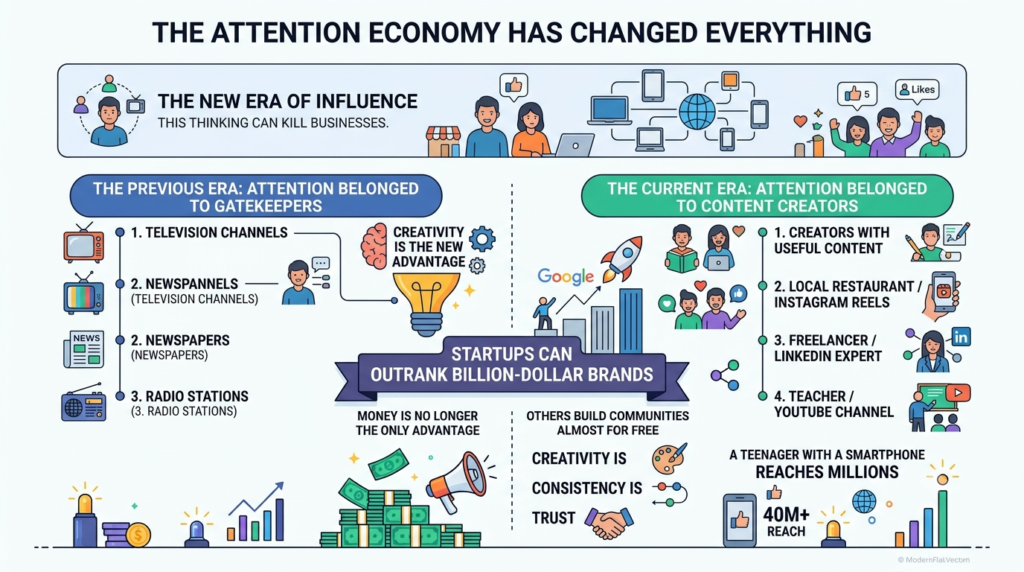
Twenty years ago, attention belonged to television channels.
Then newspapers.
Then radio stations.
Today…
Attention belongs to anyone capable of creating useful content.
A teenager with a smartphone can reach more people than a multinational company could twenty years ago.
A small startup can outrank billion-dollar brands on Google.
A freelancer can become an industry expert through LinkedIn.
A local restaurant can become famous through Instagram Reels.
A teacher can build a million-subscriber YouTube channel without buying television advertisements.
The internet changed the rules.
Money is no longer the only competitive advantage.
Creativity is.
Consistency is.
Trust is.
The Three Pillars of Zero Budget Marketing
Before we discuss platforms, understand one thing.
Every successful brand grows using the same three pillars.
| Pillar | Why It Matters |
|---|---|
| Visibility | People cannot buy what they cannot find. |
| Value | People follow brands that solve problems. |
| Trust | People buy only after they trust you. |
Most businesses focus only on visibility.
They run advertisements.
Get clicks.
Get traffic.
Then wonder why nobody buys.
Because visibility without trust creates visitors.
Visibility with trust creates customers.
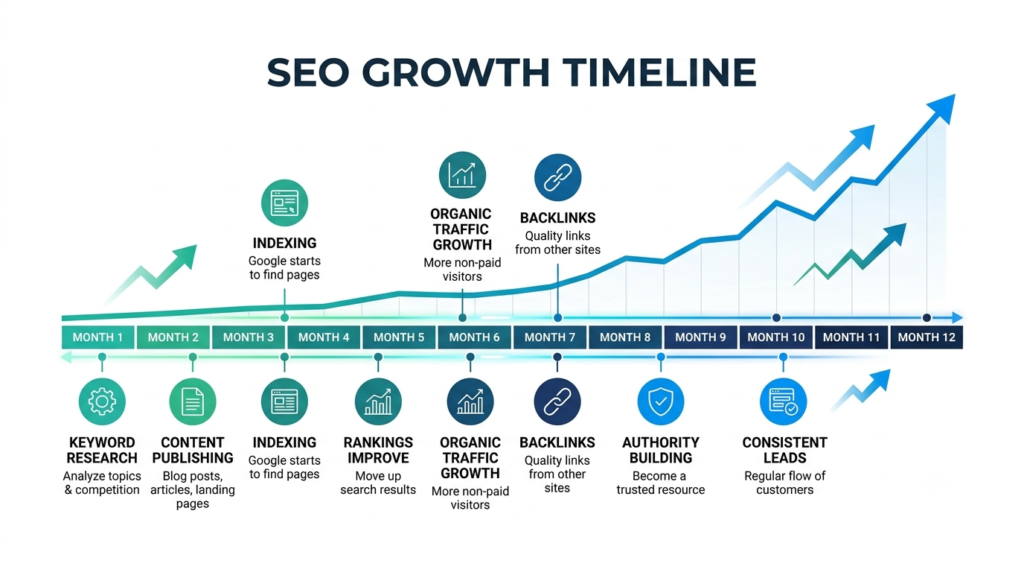
Strategy #1 – Become Discoverable Through SEO
Imagine opening a shop.
Would you build it in the middle of a forest?
Of course not.
You would choose a place where people are already searching for products.
That’s exactly what Google is.
Millions of people search every minute.
They’re not looking for advertisements.
They’re looking for answers.
Every search is an opportunity.
Instead of interrupting people with ads…
Become the answer they’re already searching for.
Suppose someone searches:
- Best budget laptop
- How to start a clothing brand
- Digital marketing guide
- Email marketing tips
- SEO checklist
Now imagine your website appears first.
You didn’t pay Google.
Google rewarded your content because it genuinely helped people.
That’s the power of SEO.
Unlike paid advertising, where traffic disappears the moment you stop spending money…
SEO keeps working.
One well-written article can generate visitors for months—or even years.
Think of every blog post as a digital employee working 24 hours a day.
While you’re sleeping…
Someone is reading your article.
Someone is discovering your business.
Someone is becoming your future customer.
That’s not an expense.
That’s an asset.
Why Blogging Is Still Underrated
Many founders believe blogging is dead.
Statistics say otherwise.
Every day, billions of Google searches happen because people want answers.
Not advertisements.
Answers.
A single helpful blog can rank for hundreds of keywords.
That means one article can bring thousands of visitors without spending a single rupee.
Ask yourself this:
Would you rather pay every month for traffic…
Or create content that keeps bringing visitors for years?
The answer seems obvious.
Yet most businesses continue choosing the expensive path.
Strategy #2 – Build Trust Before You Try to Sell
Here’s a mistake almost every beginner makes.
Day One.
Instagram account created.
First post.
“Buy Now.”
Nobody buys.
Because strangers don’t purchase from strangers.
Trust always comes first.
Imagine walking into a crowded marketplace.
A shopkeeper you’ve never seen before immediately says,
“Sir, please buy this.”
You walk away.
Now imagine another shopkeeper.
He explains the product.
Shows how it works.
Shares customer experiences.
Answers your questions.
Offers free advice.
Even if you don’t buy immediately…
You remember him.
That’s marketing.
The same psychology exists online.
Instead of constantly selling…
Teach.
Explain.
Educate.
Help.
Every helpful piece of content becomes a trust-building investment.
And trust compounds over time.
The 80/20 Rule Every Brand Should Follow
Most successful creators unknowingly follow a simple principle.
| Content Type | Percentage |
|---|---|
| Educational Content | 80% |
| Promotional Content | 20% |
Unfortunately…
Most businesses do the opposite.
80% promotions.
20% value.
Then they wonder why engagement is declining.
People open social media to learn.
To laugh.
To solve problems.
Not to be sold something every minute.
If your content improves someone’s life…
They’ll remember your brand long before they need your product.
Give First. Sell Later.
This might sound strange.
But the fastest way to sell is often by not trying to sell.
Think about companies you trust.
They constantly publish blogs.
Free tools.
Guides.
Templates.
Case studies.
Videos.
Podcasts.
Newsletters.
They’re teaching long before they’re selling.
Because educated customers make faster buying decisions.
Ask yourself every morning:
“How can I make someone’s work easier today?”
Not…
“How can I sell more today?”
The first question builds a brand.
The second builds temporary revenue.
Only one survives for decades.
A Brand Is a Memory, Not a Logo
Many people think branding means choosing colors.
Designing logos.
Creating fancy packaging.
Those things matter.
But they aren’t the brand.
A brand is simply what people remember when your name appears.
If someone hears your company’s name…
What comes into their mind?
Trust?
Quality?
Innovation?
Cheap prices?
Or nothing at all?
Every piece of content you publish shapes that memory.
Every blog.
Every reel.
Every LinkedIn post.
Every YouTube video.
You’re not just creating content.
You’re programming your audience’s perception.
And perception often becomes reality in business.
Before You Move to the Next Strategy…
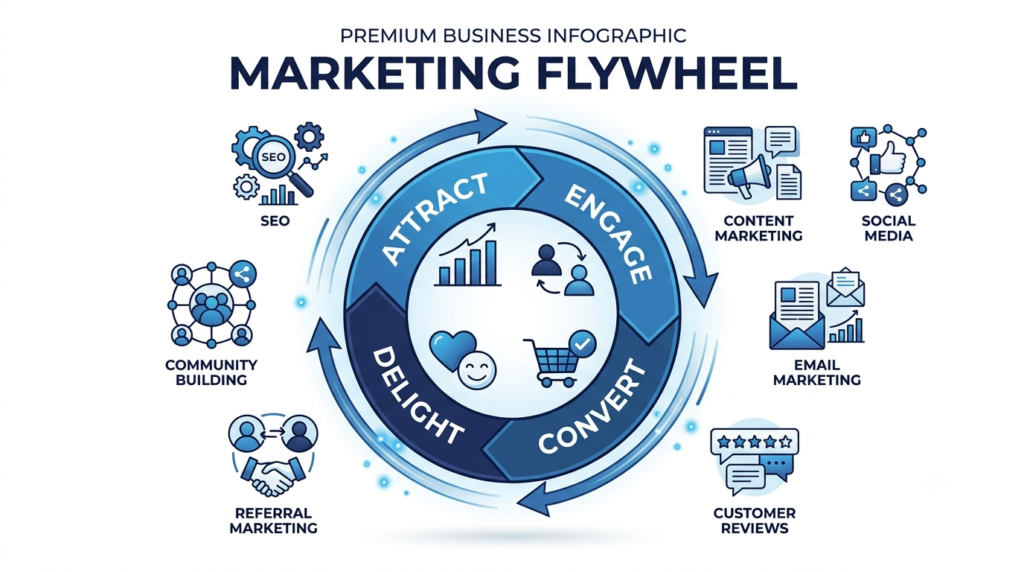
Pause for a moment.
Forget followers.
Forget likes.
Forget advertising budgets.
Answer these three questions honestly:
- Can people easily discover your business?
- Does your content genuinely help someone?
- Would a stranger trust your brand after spending five minutes on your website?
If the answer is “No” to even one of these…
Don’t worry.
That’s exactly what the next strategies will solve.
Because zero-budget marketing isn’t about finding shortcuts.
It’s about building a marketing system that keeps working long after the campaign ends.
Best Free Marketing Platforms –
| Platform | Best For | Difficulty | Long-Term Value |
|---|---|---|---|
| Google (SEO) | Organic Traffic | Medium | ⭐⭐⭐⭐⭐ |
| YouTube | Education | Medium | ⭐⭐⭐⭐⭐ |
| B2B Branding | Easy | ⭐⭐⭐⭐ | |
| Awareness | Easy | ⭐⭐⭐ | |
| Communities | Medium | ⭐⭐⭐⭐ | |
| Quora | Authority | Easy | ⭐⭐⭐ |
| Customer Retention | Medium | ⭐⭐⭐⭐⭐ |
Strategy #3 – Turn Social Media Into a Distribution Machine
One of the biggest mistakes businesses make is treating social media as a sales platform.
It isn’t.
Social media is a distribution platform.
Think of it this way.
Imagine you’ve written the world’s best blog.
If nobody reads it, does it create value for your business?
Probably not.
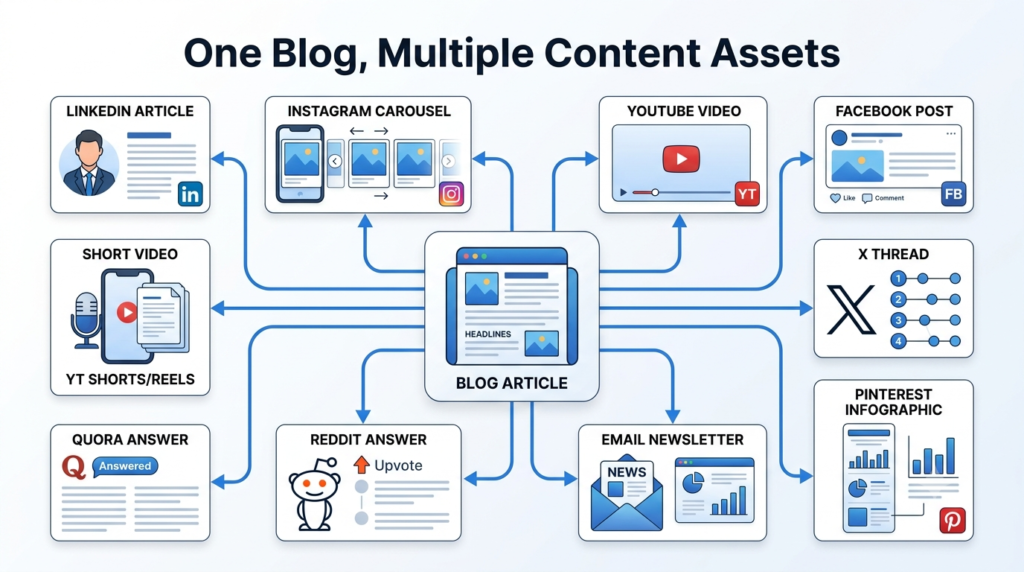
Now imagine you break that one blog into:
- An Instagram carousel
- A LinkedIn post
- Five tweets on X
- A YouTube Short
- A Facebook post
- A Pinterest infographic
- A Quora answer
- A Reddit discussion
| Original Content | Repurpose Into |
|---|---|
| Blog | LinkedIn Article |
| Blog | Instagram Carousel |
| Blog | X Thread |
| Blog | Facebook Post |
| Blog | Pinterest Infographic |
| Blog | YouTube Video |
| Blog | Newsletter |
| Blog | Reddit Answer |
| Blog | Quora Answer |
Suddenly, one piece of content becomes eight opportunities to reach people.
Successful brands don’t create more content.
They distribute content more intelligently.
That is why many businesses with small teams consistently outperform companies spending thousands on advertising.
Stop Chasing Followers. Start Solving Problems.
Many businesses celebrate when they gain 10,000 followers.
Very few ask an important question.
“How many of those followers will actually become customers?”
Follower count looks impressive.
Problem-solving builds businesses.
Imagine these two creators.
Creator A
- 500,000 followers
- Funny memes
- Viral videos
- No clear expertise
Creator B
- 8,000 followers
- Shares marketing strategies every day
- Publishes case studies
- Answers audience questions
- Helps business owners
Who do you think gets more consulting clients?
Who earns more trust?
Who builds authority?
The answer isn’t always the person with more followers.
Attention without relevance is entertainment.
Attention with expertise becomes influence.
Strategy #4 – Build a YouTube Library, Not Just Videos
Most people think YouTube is a social media platform.
It isn’t.
It is a search engine.
When someone searches:
“How to rank on Google”
“How to start a business”
“SEO tutorial”
“Email marketing guide”
They aren’t scrolling.
They’re searching.
That makes YouTube fundamentally different from Instagram.
Instagram rewards trends.
YouTube rewards knowledge.
A useful YouTube video published today can still generate views five years later.
That’s because people continue searching for the same problems.
Instead of asking,
“How do I go viral?”
Ask,
“How can this video remain useful three years from now?”
That simple shift changes everything.
Evergreen Content Always Wins
Imagine planting two trees.
The first grows quickly.
After a few weeks, it dies.
The second grows slowly.
But it gives fruit every season for decades.
Paid advertising is the first tree.
Evergreen content is the second.
Which one would you rather own?
Every blog…
Every YouTube tutorial…
Every case study…
Every downloadable guide…
These are digital assets.
Unlike advertisements, they continue working even after you stop creating new content.
Think like an investor.
Not a campaign manager.
Strategy #5 – Join Communities Before Building Your Own
Here’s something many marketers never understand.
People don’t trust logos.
People trust people.
Before trying to build your own audience…
Become useful inside someone else’s audience.
Where are your future customers already spending time?
- Quora
- LinkedIn Groups
- Facebook Communities
- Discord Servers
- Industry Forums
Don’t join to promote yourself.
Join to help.
If someone asks a question you know the answer to…
Answer it thoroughly.
If someone shares a challenge…
Offer genuine advice.
People notice consistency.
Eventually they’ll ask,
“Who is this person?”
That’s when your profile, website, and brand begin working for you.
Trust is earned through contribution.
Not promotion.
Strategy #6 – Build an Email List From Day One
Social media platforms change.
Algorithms change.
Reach declines.
Accounts get suspended.
Trends disappear.
Your email list doesn’t.
Imagine spending five years building an Instagram audience.
One algorithm update reduces your reach by 80%.
Now imagine spending five years building an email list.
Every subscriber still belongs to your business.
That’s why experienced marketers say:
Followers are rented.
Email subscribers are owned.
Offer something valuable.
A checklist.
An ebook.
A template.
A free course.
A resource people genuinely need.
Instead of collecting followers…
Collect relationships.
Because businesses don’t grow through impressions.
They grow through conversations.
Strategy #7 – Build a Personal Brand Alongside Your Business
People connect with faces before logos.
Think about companies you admire.
Can you name their founders?
Probably yes.
That’s because personal branding accelerates business branding.
Share your journey.
Talk about failures.
Celebrate small wins.
Document lessons.
Show behind the scenes.
People love watching progress.
They don’t expect perfection.
This approach is often called “Build in Public.”
Instead of saying,
“We are successful.”
Show people how you’re becoming successful.
Authenticity creates emotional investment.
And emotional investment creates loyal customers.
The Biggest Mistakes in Zero Budget Marketing
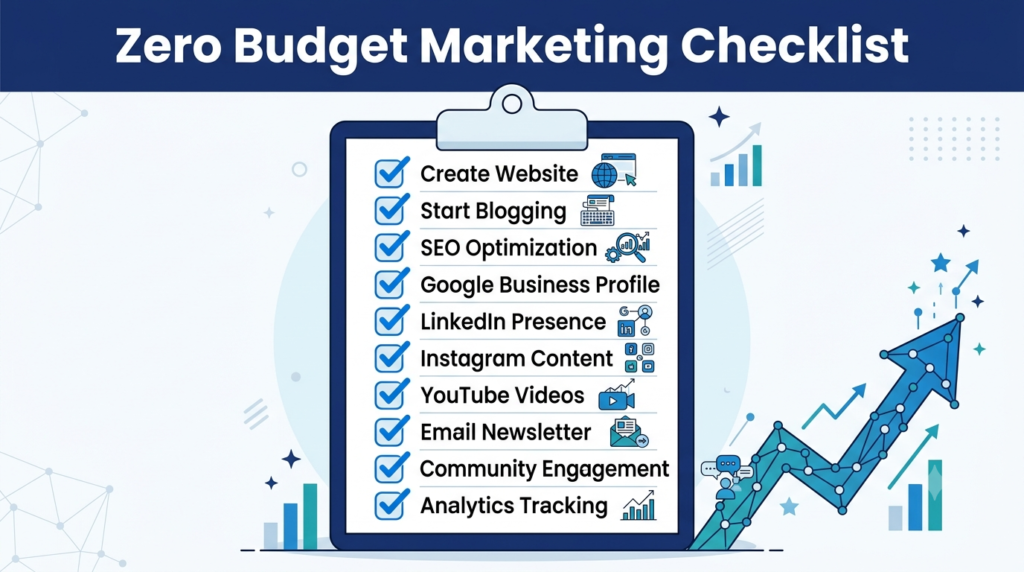
Many businesses don’t fail because they lack money.
They fail because they make avoidable mistakes.
| Mistake | Better Approach |
|---|---|
| Selling immediately | Build trust first |
| Posting randomly | Follow a content strategy |
| Ignoring SEO | Create searchable content |
| Depending on one platform | Diversify distribution |
| Chasing viral content | Focus on valuable content |
| Measuring only followers | Measure trust, leads, and conversions |
| Giving up too early | Stay consistent for months |
Consistency beats intensity.
Every single time.
Your 90-Day Zero Budget Marketing Roadmap
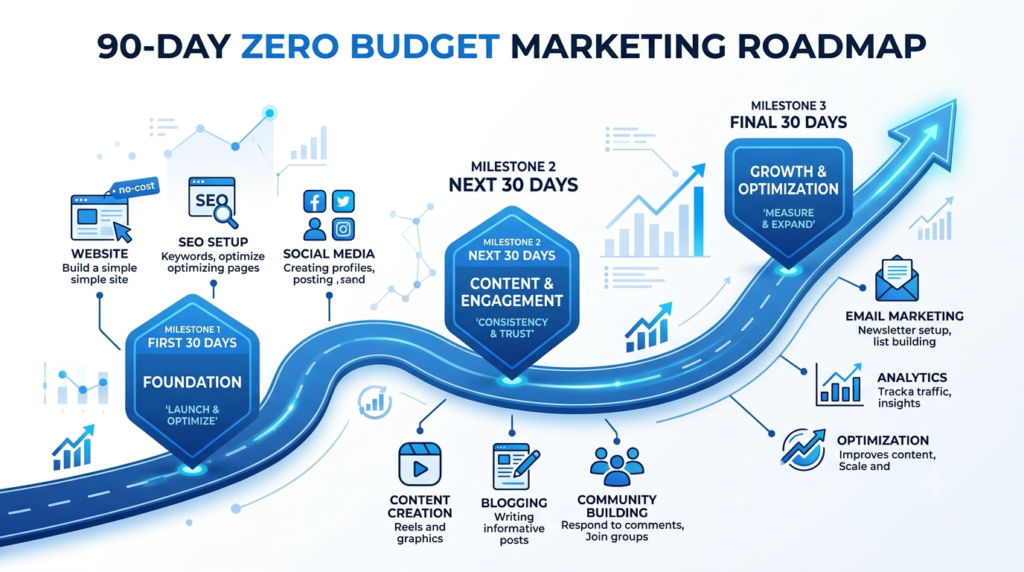
Most businesses don’t need another marketing course.
They need a system.
Month 1 – Build Your Foundation
- Launch a professional website.
- Publish four in-depth blog articles.
- Optimize your Google Business Profile.
- Create LinkedIn, Instagram, and YouTube accounts.
- Define your audience and niche.
Focus on visibility.
Month 2 – Build Authority
- Publish one helpful blog every week.
- Create three to five social media posts from each blog.
- Answer questions on Quora and Reddit.
- Start collecting email subscribers.
- Create one downloadable free resource.
Focus on trust.
Month 3 – Build Momentum
- Improve older blog posts.
- Repurpose top-performing content.
- Collaborate with creators in your niche.
- Launch a weekly newsletter.
- Analyze which content drives the most traffic.
Focus on consistency.
After ninety days, you won’t become famous.
But you’ll have something much more valuable.
A marketing engine.
One that continues generating traffic while you focus on building your business.
The Psychology Behind Great Marketing
Every purchase begins inside the human mind.
People rarely buy because a product exists.
They buy because they believe it solves a problem.
Great marketing understands psychology.
People want certainty.
They want trust.
They want belonging.
They want confidence.
The brands that understand human emotions almost always outperform brands that only talk about features.
Nobody buys a drill because they love drills.
They buy because they want a hole in the wall.
Nobody buys marketing services because they love SEO.
They buy because they want customers.
Always sell the outcome.
Not the tool.
Final Thoughts
Thousands of businesses launch every year.
Most disappear quietly.
Not because their products were bad.
Not because their ideas lacked potential.
But because nobody knew they existed.
The internet has made marketing more democratic than ever before.
Today, the biggest advantage isn’t money.
It’s the ability to consistently create value.
The brands that educate win.
The brands that help win.
The brands that build trust win.
Remember this whenever you feel your marketing budget is too small:
Marketing is not about spending more money. Marketing is about earning more attention.
Money can buy clicks.
It can buy impressions.
It can even buy temporary visibility.
But it cannot buy genuine trust.
Trust is earned one helpful article, one insightful video, one honest conversation, and one satisfied customer at a time.
If you commit to showing up consistently, solving real problems, and creating content that people genuinely find useful, your business won’t just attract customers—it will build a community.
And in today’s digital world, communities are far more valuable than campaigns.
Because campaigns end.
Communities don’t.
📌 SEO FAQs
1. Can I grow my business without spending money on marketing?
Yes. Businesses can grow organically by focusing on SEO, content marketing, social media, email marketing, and community engagement. These strategies require consistency and time rather than advertising budgets.
2. Which free digital marketing method works best for beginners?
SEO and content marketing are among the most effective long-term strategies because they continue generating traffic long after the content is published.
3. How long does zero budget digital marketing take to show results?
Most businesses start seeing measurable results within three to six months if they consistently publish valuable content and optimize it for search engines.
4. Is social media enough to grow a business?
No. Social media should be combined with SEO, email marketing, and a website. Relying only on one platform is risky because algorithms change frequently.
5. What’s the biggest mistake in zero budget marketing?
Trying to sell before building trust. Successful brands educate, solve problems, and earn attention before asking customers to buy.
Sources & References
- Google Search Central – https://developers.google.com/search
- Ahrefs Blog – https://ahrefs.com/blog
- Search Engine Journal – https://www.searchenginejournal.com

Your blog is a treasure trove of valuable insights and thought-provoking commentary. Your dedication to your craft is evident in every word you write. Keep up the fantastic work!